
Production Planning in Manufacturing: Complete Guide
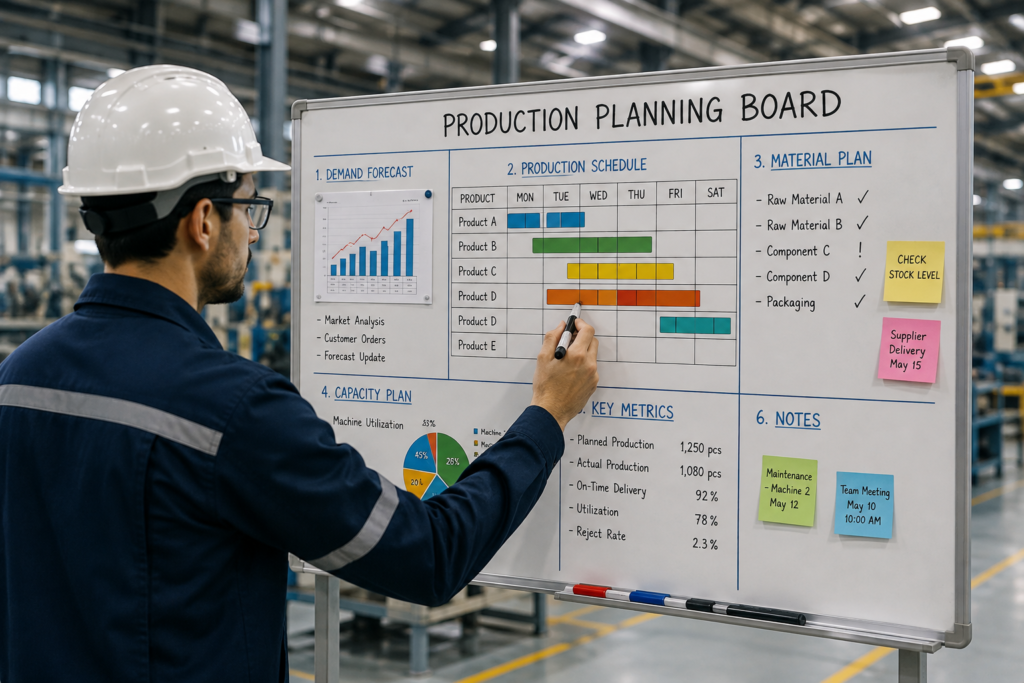
In modern industrial operations, staying competitive requires more than just high-quality products and skilled labor. It demands an orchestrated strategy to handle resources, timelines, inventory, and volatile market demands. This is where production planning in manufacturing serves as the backbone of operational success. Without structured planning, factories face costly downtime, excess inventory, supply chain bottlenecks, and missed delivery deadlines.
Whether you operate a small job shop or manage a global multi-plant enterprise, implementing a robust production planning strategy ensures that your facility operates at peak efficiency. In this comprehensive guide, we will explore the core concepts, detailed processes, primary models, key challenges, and modern software technologies driving manufacturing planning today.
Table of Contents
- What Is Production Planning in Manufacturing?
- Why Production Planning Is Important
- The Production Planning Process
- Types of Production Planning
- Benefits of Effective Production Planning
- Common Production Planning Challenges
- How ERP Improves Production Planning
- Best Practices for Success
- Frequently Asked Questions
- Conclusion
What Is Production Planning in Manufacturing?
Production planning in manufacturing is the strategic administrative framework used to allocate physical assets, raw materials, labor, and machine capacity to meet customer demand efficiently. It establishes a detailed roadmap for manufacturing operations, answering key operational questions: What to produce? How much to produce? When to produce it? Where to build it? and Which resources are required?
At its core, this planning discipline bridges the gap between sales demand and shop-floor execution. It coordinates short-term operational schedules with long-term business goals, ensuring raw materials arrive precisely when needed and finished goods ship out on schedule. To learn more about how foundational enterprise software supports these frameworks, read our guide on What Is Manufacturing ERP?.
Why Production Planning Is Important
Without a structured approach to planning, manufacturing facilities operate reactively rather than proactively. Unplanned operational shifts lead to severe cost overruns, wasted materials, and dissatisfied customers. Effective production planning in manufacturing empowers organizations to:
- Maximize Resource Utilization: Keep machines, tools, and labor operating at target efficiency rates without overloading floor capacity.
- Minimize Inventory Overhead: Reduce excess raw material holdings and Work-In-Progress (WIP) items that tie up vital working capital.
- Enhance On-Time Delivery Rates: Predict precise lead times to give reliable delivery commitments to clients.
- Mitigate Supply Chain Risks: Anticipate material shortages, equipment downtime, and labor constraints before they create major disruptions.
The Production Planning Process
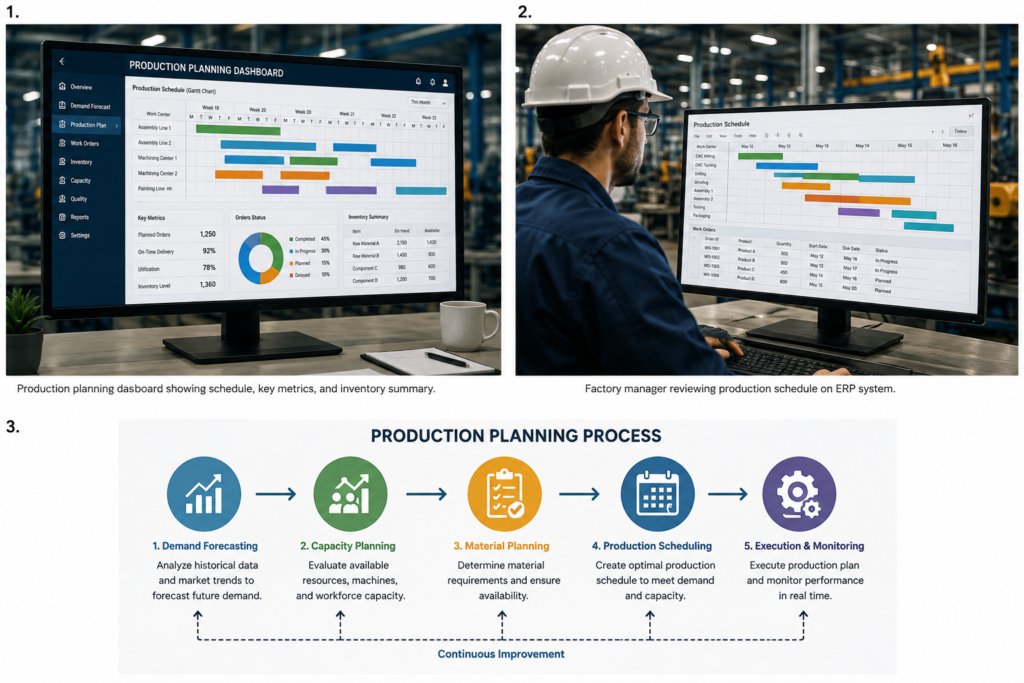
A well-structured planning framework relies on systematic steps that convert high-level demand forecasts into granular shop-floor instructions. The standard process involves five interconnected phases
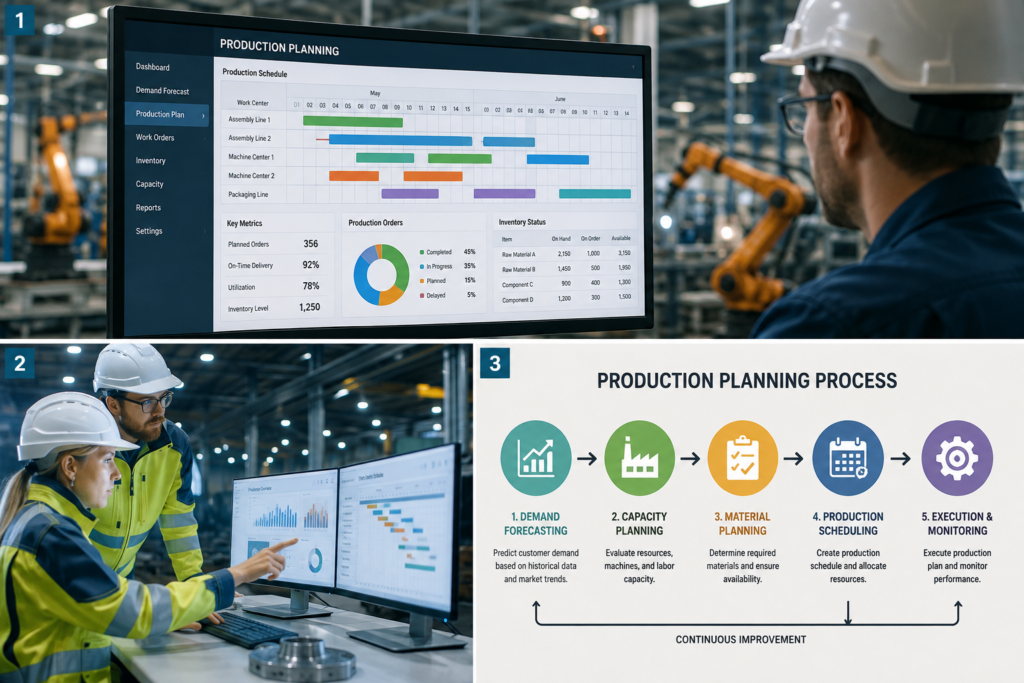
1. Demand Forecasting
Demand forecasting uses historical sales trends, market analytics, economic indicators, and seasonal patterns to project future product demand. Accurate forecasts prevent overproduction and underproduction, forming the foundation of a reliable master production schedule.
2. Capacity Planning
Capacity planning evaluates whether a facility’s machinery, workforce, and space can handle forecasted demand. It helps managers determine if they need extra shifts, temporary labor, equipment upgrades, or sub-contracting to meet production targets.
3. Material Planning
Material Requirements Planning (MRP) ensures that all raw materials, sub-assemblies, and components are available when needed. It calculates exact component quantities based on the Bill of Materials (BOM) and aligns purchase orders with production schedules. To understand how MRP connects with broader enterprise management systems, see our comparison of ERP vs MRP.
4. Production Scheduling
Production scheduling translates overall operational plans into actionable short-term timetables. It assigns specific jobs to individual machines, workers, and assembly lines, detailing exact start and end times for every job step.
5. Execution and Monitoring
Once plans are released to the shop floor, real-time monitoring tracks progress against the plan. Advanced Internet of Things (IoT) sensors, barcode scanners, and MES systems catch delays, equipment failures, or defect spikes early, allowing teams to adjust plans immediately.
Types of Production Planning
Different manufacturing strategies require distinct planning techniques based on product complexity, market demand, and order volumes. Below is a comparison of the primary strategies used in production planning in manufacturing:
| Strategy Type | Primary Focus | Inventory Level | Lead Time | Best Suited For |
|---|---|---|---|---|
| Make-to-Stock (MTS) | Demand Forecasting | High (Finished Goods) | Short (Immediate) | Consumer packaged goods, standardized items |
| Make-to-Order (MTO) | Custom Orders & Order Backlog | Low (Raw Materials) | Medium | Specialty machinery, customized vehicles |
| Engineer-to-Order (ETO) | Project Engineering & Design | Very Low | Long | Industrial infrastructure, complex aerospace parts |
Make-to-Stock (MTS)
The Make-to-Stock approach relies on sales forecasts to build inventory before customer orders arrive. Production runs continuously to maintain safe warehouse inventory levels. This strategy works best for standardized, high-volume products with predictable market demand.
Make-to-Order (MTO)
Under Make-to-Order systems, manufacturing begins only after receiving a confirmed customer order. This minimizes finished-goods holding costs and product obsolescence risks, but requires flexible production lines to handle varying order sizes.
Engineer-to-Order (ETO)
Engineer-to-Order environments design, engineer, and build unique products customized to individual customer specifications. Planning in ETO settings focuses on project milestone management, complex procurement cycles, and direct engineering collaboration.
Benefits of Effective Production Planning
Implementing a modern strategy for production planning in manufacturing offers substantial financial and operational benefits across your organization:
- Reduced Manufacturing Costs: Eliminates overtime expenses, reduces material scrap, and minimizes machine idle time.
- Shorter Manufacturing Cycle Times: Streamlines material movement through the plant floor, cutting total throughput time.
- Optimized Procurement: Gives purchasing teams precise material requirements, helping them negotiate better bulk pricing and delivery terms with suppliers. Professional frameworks from APICS / ASCM offer global standards for structuring these procurement networks.
- Improved Customer Satisfaction: Reliable delivery dates build trust and improve long-term client retention rates.
Common Production Planning Challenges
Despite its benefits, maintaining an effective planning schedule presents ongoing challenges due to shop-floor realities and broader market forces:
- Inaccurate Demand Forecasts: Sudden market shifts, economic volatility, or poor historical data can ruin master schedules, causing stockouts or excess inventory.
- Supply Chain Disruptions: Unreliable material deliveries, port delays, or vendor quality failures halt production lines unexpectedly.
- Unplanned Equipment Downtime: Sudden machinery breakdowns create bottlenecks that throw off downstream schedules.
- Data Silos: Legacy systems and manual spreadsheets fragment critical plant data, delaying decisions across operations teams.
How ERP Improves Production Planning
Modern enterprise management software transforms traditional planning by offering real-time visibility, automated scheduling, and centralized data management across departments. Modern enterprise software platforms such as Microsoft Dynamics 365 Manufacturing and Oracle Manufacturing integrate business functions directly into unified shop-floor management tools.
Here is how Enterprise Resource Planning (ERP) systems elevate production planning in manufacturing:
- Automated Material Planning: ERP systems automatically recalculate material needs, generate purchase orders, and adjust schedules whenever orders change.
- Advanced Planning and Scheduling (APS): Modern platforms use algorithms to run infinite or finite capacity models, automatically re-routing work orders around broken machines or bottlenecked work centers.
- Real-Time Shop Floor Visibility: Integrated barcode scans and machine IoT signals provide live tracking of job statuses across every work station.
To successfully integrate these tools into your business operations, consult our step-by-step Manufacturing ERP Implementation Guide, or explore the Top 10 Benefits of ERP in Manufacturing.
Best Practices for Success
To optimize your planning operations and maximize throughput, apply these industry best practices:
- Maintain Clean Master Data: Ensure your Bills of Materials (BOMs), routings, lead times, and work center capacities remain current and accurate within your system.
- Adopt Predictive Maintenance: Move from reactive maintenance to sensor-driven predictive programs. Preventing unexpected machine breakdowns helps maintain predictable production output.
- Establish Cross-Functional Communication: Keep sales, procurement, production, and logistics teams aligned through regular Sales and Operations Planning (S&OP) meetings.
- Continuously Analyze Key Metrics: Track key performance indicators (KPIs) such as Overall Equipment Effectiveness (OEE), Schedule Attainment, Cycle Time, and On-Time In-Full (OTIF) delivery metrics.
Frequently Asked Questions
What is production planning in manufacturing?
Production planning in manufacturing is the administrative process of allocating raw materials, machinery, labor, and time to build goods efficiently. It aligns production output with customer demand while optimizing costs, resource use, and throughput times.
What are the five stages of production planning?
The five core stages of production planning are:
- Demand Forecasting: Predicting future product sales.
- Capacity Planning: Evaluating operational production capabilities.
- Material Planning (MRP): Securing required components and raw materials.
- Production Scheduling: Creating detailed job timetables for equipment and labor.
- Execution and Monitoring: Tracking shop-floor output and adjusting operations in real time.
What is the difference between production planning and production scheduling?
Production planning focuses on broader long-term strategy, identifying what products to manufacture, overall resource requirements, and general timeframes. Production scheduling translates that high-level plan into immediate operational execution, assigning specific tasks to individual machines and operators down to the minute.
How does ERP improve production planning?
An ERP system centralizes operational data, automates Material Requirements Planning (MRP), offers real-time inventory tracking, and automatically balances capacity across workstations. This reduces manual scheduling mistakes, lowers operational costs, and speeds up plant throughput.
What are the biggest challenges in production planning?
The primary challenges include inaccurate sales demand forecasts, unexpected supply chain disruptions, equipment breakdowns, manual spreadsheet reliance, and poor communication between procurement and shop-floor management teams.
Conclusion
Mastering production planning in manufacturing is essential for companies aiming to boost operational efficiency, lower production costs, and maintain customer satisfaction. By structuring a disciplined planning workflow—from precise demand forecasting down to real-time shop-floor execution—manufacturers can systematically eliminate operational bottlenecks and optimize inventory levels.
Adopting digital enterprise systems like modern ERP platforms gives manufacturing teams real-time operational visibility and automated scheduling capabilities. Pairing robust technology platforms with industry best practices helps build a resilient, flexible manufacturing operation capable of adapting quickly to changing market conditions.
