
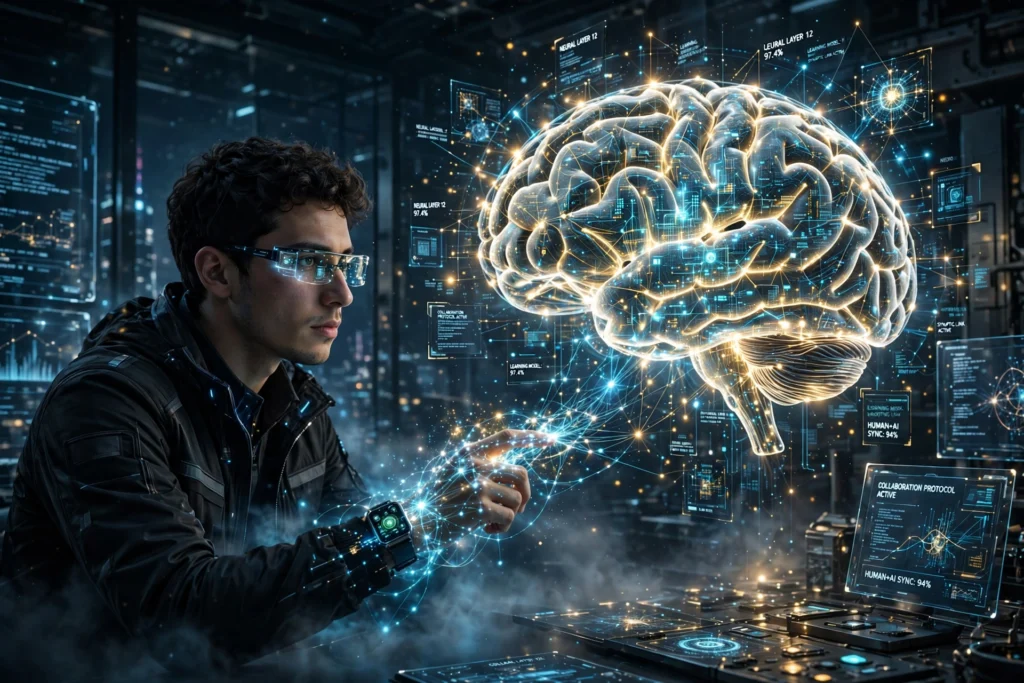
Artificial intelligence is the most transformative technology of our generation. More than just automation, modern AI represents a fundamental shift in how we process information, create value, and solve humanity’s most complex challenges. From the generative AI tools reshaping creativity to the machine learning models powering scientific breakthroughs, the true AI benefits are only beginning to emerge. Understanding the future of AI is essential for anyone navigating the modern digital landscape.
What Makes AI Truly Great?
The greatness of AI does not lie in a single capability, but in its convergence of multiple superhuman strengths. Unlike previous technologies that excelled at one task, artificial intelligence combines perception, reasoning, and generation. According to research from Stanford HAI, modern AI systems are moving from narrow task automation to general-purpose problem solving, creating an unprecedented platform for innovation.
- Augmentation, not replacement: AI enhances human expertise.
- Exponential learning: Models improve with every interaction.
- Universal accessibility: Cutting-edge intelligence is now available via API and app.
5 Core Strengths of Modern AI
1. Unmatched Data Processing
Human cognition is limited by time and attention. AI has no such limits. A single machine learning model can analyze millions of documents, images, or genomic sequences in minutes, finding patterns invisible to the human eye. This capability is revolutionizing industries where data volume exceeds human capacity. As highlighted in McKinsey’s State of AI Report, organizations leveraging AI for data-driven decisions are reporting 2-3x higher performance gains.
2. Generative Creativity
For the first time, machines can create. Generative AI models can write code, compose music, design products, and generate photorealistic images from text prompts. This is not mimicry; it is combinatorial creativity at scale. Research from OpenAI Research shows that generative models are developing emergent abilities to reason and solve novel problems, fundamentally changing creative workflows for writers, designers, and developers.
3. Personalization at Scale
AI makes mass personalization economically viable. Streaming platforms, e-commerce stores, and learning apps use artificial intelligence to tailor experiences for billions of individuals simultaneously. This level of personalization was impossible before. Instead of one-size-fits-all, AI delivers one-size-fits-one, improving learning outcomes, health recommendations, and customer satisfaction without increasing human labor.

4. Revolution in Healthcare and Science
Perhaps the greatest AI benefit is in science. AI is accelerating drug discovery, predicting protein structures, detecting cancers earlier than radiologists, and modeling climate change. What once took a PhD team a decade can now be simulated in days. This is not just efficiency; it is expanding the frontier of human knowledge. The ability to process biological data at scale is saving lives and will define the next century of medicine.
5. Democratizing Knowledge
Historically, expert knowledge was scarce and expensive. AI democratizes it. A student in Jakarta now has access to a personal tutor that can explain quantum physics, debug code, and edit essays in fluent English. Small businesses can access marketing, legal, and financial analysis that once required consultants. By lowering the cost of intelligence, artificial intelligence is one of the most powerful equalizers for economic opportunity.
The Future is Human + AI Collaboration
The most profound shift is not AI versus humans, but humans plus AI. As explored by MIT Technology Review, the future of AI is collaborative intelligence. The best outcomes emerge when human judgment, empathy, and creativity are paired with AI’s speed, scale, and recall. Writers who use AI write better. Doctors who use AI diagnose more accurately. The question is no longer if you will work with AI, but how well you will collaborate with it.
Conclusion: Embracing the Greatness
The greatness of AI lies not in its ability to be human, but in its ability to make humans greater. It handles the tedious to free us for the meaningful, processes the massive to reveal the essential, and generates the novel to inspire the next idea. To prepare for this future, start experimenting today. Learn to prompt, build small automations, and view AI as a thought partner. The transformation is already here — those who embrace human-AI collaboration will lead the next decade.
Sources & Further Reading
- Stanford Institute for Human-Centered AI (HAI) – Human-centered AI research and policy
- McKinsey: The State of AI in 2023-2024 – Global survey on enterprise AI adoption
- OpenAI Research – Latest advances in generative AI and foundation models
- MIT Technology Review: Artificial Intelligence – In-depth journalism on AI impact
